This article was written by the members of the Journalism class.
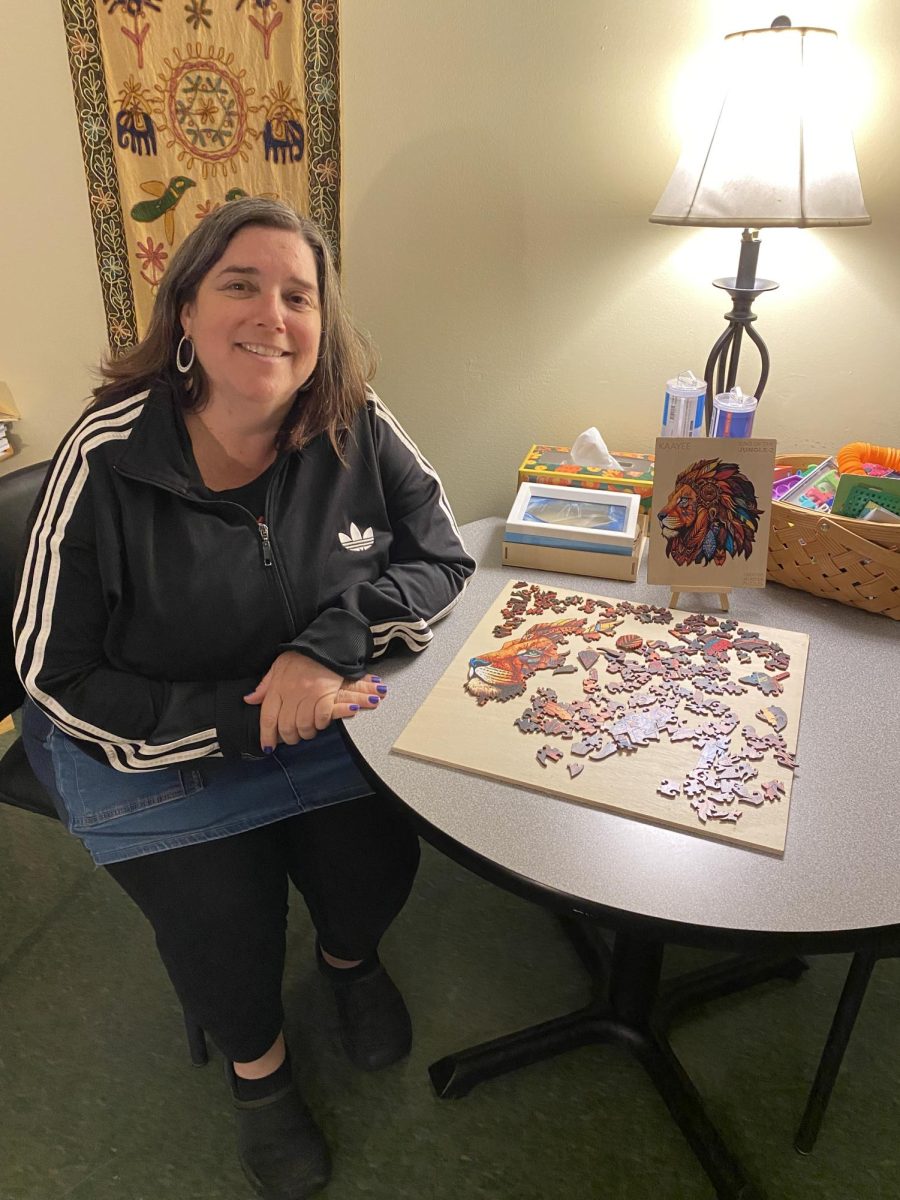
On Wednesday, November 13th, our new principal Rebecca Tatistcheff sat down with the journalism class to answer questions about the most up-and-coming topics around U-32. This is the third article in an ongoing series called Principal’s Press.
11/13 Topics:
- A Day in the Life of Becca
- Sports at U-32
- Substitute Teachers at U-32
- Education Standards
- J-Term
A day in the Life of Becca
By Grace Cannella
A day in the life of the U-32 principal mostly consists of talking and walking. In the morning, Becca greets people by the door. This is very important to her because, “I’m excited to see you every day,” she said.
Knowing everyone’s names is also a value of hers. It makes her feel more connected with the students. She is working to learn everyone’s names. “Some flash cards would be great,” Becca joked.
After greeting students and staff, she has meetings with other administrators. Becca values her relationships with students, and in addition to greeting at the door, she wanders around and talks to students. Being the new principal, Becca wants to start building strong connections with the students at U-32.
She also goes to classes and observes students learning as well as teachers teaching. Due to math teacher Steven Ushakov leaving on paternity leave Becca teaches an Algebra 1 class.
She has a lot of experience with teaching math and has taught at least one math class for the past six years. On Wednesdays, Becca also teaches a middle school flex class.
A big part of Becca’s job is connecting with students. She wants to hear students’ opinions and questions to make U-32 a better place. This is important to “make change and resolve problems,” she says.
Sports at U-32
By Molly Pepin
Becca Tatistcheff collaborates with Derek Dunning to organize school sports games. Although Derek is mainly involved in arranging the sports game schedule, Becca provides support. “[We have] an amazing sports program, and it runs really well. And so, when there are hiccups, I’m here to kind of help problem solve through those,” said Becca. Becca is also involved in providing space for home games. She may attend sports games to make sure that one member of the leadership team is present.
Becca also meets with Derek to discuss how games are going. They talk about hiring new sports coaches, the budget, the sports team status, and transitioning into the winter sports season.
As teams transition out of their fall sports many are either in preseason or have open gym. “Then it’s about collecting all of the stuff from fall sports and gearing up and making sure that we’re fully ready [for the next season],” said Becca. Becca checks in with Derek during the transition process.
Substitute Teachers at U-32
By Inkwel Young
In the Washington Central school district, substitute teachers are essential to keeping schools like U-32 open. Because of this, there is a districtwide system in place to find substitute teachers. Becca Tatistcheff has insights into how this process works.
Substitutes are volunteers that can sign up through the Washington Central Unified Union School District. A list of absent teachers is sent out in an email to all possible substitutes. There, they can sign up to cover a class.This list continues to be available throughout the week.
“The idea is that subs are centralized and then can go to all of the schools in the district,” said Becca.
What happens when there are not enough substitutes to fill the absences on a given day? On days when there are too many absences, and not enough substitutes at U-32, a decision can be made to shorten the school day.
“Sometimes what we do is we move teacher planning time to the afternoon so that folks can be able to sub for classes in the day,” Becca said. This allows the school to stay open, even without enough substitutes to cover for every class.
Education Standards
By Gregory Hayward
There are numerous ways the state and federal government ensure that U-32 stays on top of curriculum and student performance. Becca said, “There are content area standards, which in the state of Vermont, they’ve adopted through national standards, like the Common Core State Standards Code. And then there is something called the EQS, which is the ED[ucation] quality standard, which is adopted by the Vermont State Legislature.”
The Common Core State Standards (CCSS) are a series of codes and standards adopted by over 40 states nationwide. As to how they use these standards, “What happens is that the agency of education takes them, [says], ‘These are the standards that we follow in the state of Vermont’. And then we take those and develop proficiency with them, and those become the things that help us know, how are you doing as students, what are you learning, what does learning look like?” Said Becca.
Beyond the CCSS, the EQS is used by the state to mandate things such as proficiency based learning and graduation requirements, Vermont Multi-tiered System of Supports (VTmtss), assessment systems, and personalized learning plans.
“The ED quality standards give the guidelines for schools to work within, and we have a committee called the ED quality committee as a part of the school board that works on making sure that we’re following those ED quality standards,” said Becca.
J-Term
By Margo Cannella
Two years ago U-32 had YES, which stands for Year End Studies. YES was an opportunity for all students at U-32 to sign up for three courses of personal interest. Some examples include learning how to cook, painting and other arts, and sports activities.
Last year, YES was changed to J-Term, which is the same idea, but takes place in January instead of at the end of the year. Some of the activities are different, because of the change of season, but there are still a variety to choose from.
Becca Tatistcheff has some involvement in J-Term, mostly related to giving feedback to the committee who pitches all the ideas. Becca also tries to build her own awareness on what courses are being offered.
Some concerns Becca has about J-Term programming are, “What are the finances surrounding it? When? What are the timelines?” These concerns are partially in her control, but other things are mainly up to the J-Term committee, like what courses are being offered.
Becca said, “We have an amazing team working on that…[the J-Term team is full of] really talented adults who are willing to facilitate things that they’re super passionate about.” She would like to be involved in teaching a course this January, after she sees what students are interested in.
At Becca’s previous school, Cabot, they did something similar to J-Term. There were interest-based trips in June: Becca was in a group that wanted to explore libraries and independent bookstores of Vermont, on a tour. She was involved in chaperoning that trip, which she found very interesting.
Becca said that she’s very excited for J-Term this year and hopes that the student body is as well.