


How do we manage temperatures in the U-32 building? With rising temperatures from global warming, are there plans for adding AC units? Has this been considered?
As many students and staff at U-32 can attest to, the air and temperature of the building is not consistent. With rising temperatures around the globe, the fall and spring weather has made the building feel warmer and stuffier. “As temperatures are getting warmer, I’m wondering if it might be worth investing in an AC unit,” said Duncan Schrader, senior here at U-32. Have you wondered the same?
If you don’t know much about U-32s building systems, here is some background information. There are two oil boilers, and one wood chip boiler. At U-32 the admin area, science lab, student services, library and auditorium all have air conditioning units. Chris O’Brien, Director of Facilities, assured there have definitely been discussions about adding AC units to all the buildings in the district, especially because the elementary schools have nothing. During these “shoulder seasons” (the months before school ends and the few months after school begins in the fall) have been becoming increasingly hotter over the years, due to climate change.

AC units are very expensive. There were plans to move forward with the talk about installing a cooling system, but with the recent budget cuts, this will be even harder to get funding for. To update the system at U-32, we would need a major upgrade to the large cooling tower on the roof. O’Brien questions if the state would help fund this hypothetical project, and guesses they probably wouldn’t. “It would be taxpayer funded, like most of our capital projects,” said O’Brien.
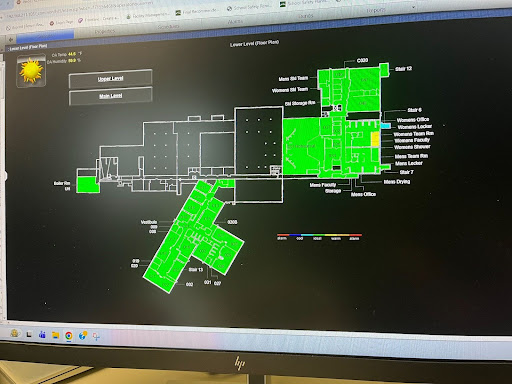
Because of the recent budget cuts, a lot of the improvement projects have been put on hold. “Air conditioning wasn’t on the list yet. It’s still not on the list. It’s just preliminary discussions around how that would look and what costs would be. We don’t have any solid plans yet. It’s just kind of in the discussion phase. It’s been brought up three or four or five different times. When it’s really hot in the building, people start talking,” said O’Brien.
And talk they do. The ventilation, air quality, and temperature of the rooms seem to vary. Many people have their own idea of which room has it worst. The places students think the air is particularly bad are the rooms with no windows for ventilation, like Randy Brown and Nick Holquist’s room. Some places have bad air and temperature. Riley Cadorette, senior, said, “[The air] is pretty bad in the band area, it’s a bit clogged. It feels hazier down there than anywhere else in the school.”
Additionally, Schrader has an opinion on which room has the worst ventilation and regulation of temperature in the building. “The senior lounge is pretty bad. If you want to be toasty, if you’re a little cold, come to the senior lounge, we’ll accept you for maybe a minute,” said Schrader. In addition, he also noted the weight room being too hot.
It is difficult to keep the building’s temperatures consistent. The biggest challenge in regulating the building’s temperature is in between seasons, when it is 45 degrees in the morning but 90 by the end of the day. “So do you turn the heat on knowing that at 11 o’clock it is going to be 95 degrees in the building?” said O’Brien. He noted that managing the spring and fall, in between seasons, is the hardest. “People get cold, and then it’s like, well, if we turn the heat on, we’re gonna have all the windows open by 10 o’clock.”
Geoff Green, teacher at U-32 echoed this statement. “It seems hard to find an equilibrium,” said Green. His room is one of many that tends to be very warm throughout the day. “My solution is to just open the windows and then the room gets really cold, really fast, and then we close the windows, and then it gets really hot, really fast,” Geoff said. The regulation of temperature is a constant debate in Geoff’s classrooms. “Basically, I’m either shivering or sweating in that class. Geoff has had to settle many disputes over if people want the window closed or open, and it’s sometimes a slight distraction for learning,” said Grace Cannella, a U-32 student.
Schrader thinks there is a more immediate response to be taken to cool down the school. “If people said yes to funding for AC units, I would also say yes to funding. What I’d be more in favor of is getting more fans and turning them on.” He noted that there are large fans sitting around school, against walls, “probably collecting dust, that could be used in an upstairs hallway. It could be used in any hallway. It could be used in doorways. More fan usage would be great. You could be wearing T shirts and shorts here and still be toasty,” said Schrader.
Overall, the inconsistent temperatures in the school are making people uncomfortable. This is frustrating to many. “I should not be sweating by sitting down in class. Maybe if I was in gym class, that would add up, but I’m in science, and I’m already hating the work, so being hot and very uncomfortable and having beads of sweat starting on your forehead is not enjoyable,” Schrader said. It seems as though changes are needed to the temperature and ventilation regulation in the building, especially with the growing pressure of global warming. “It’s definitely a hot topic at U-32,” said Cannella (pun intended).

