


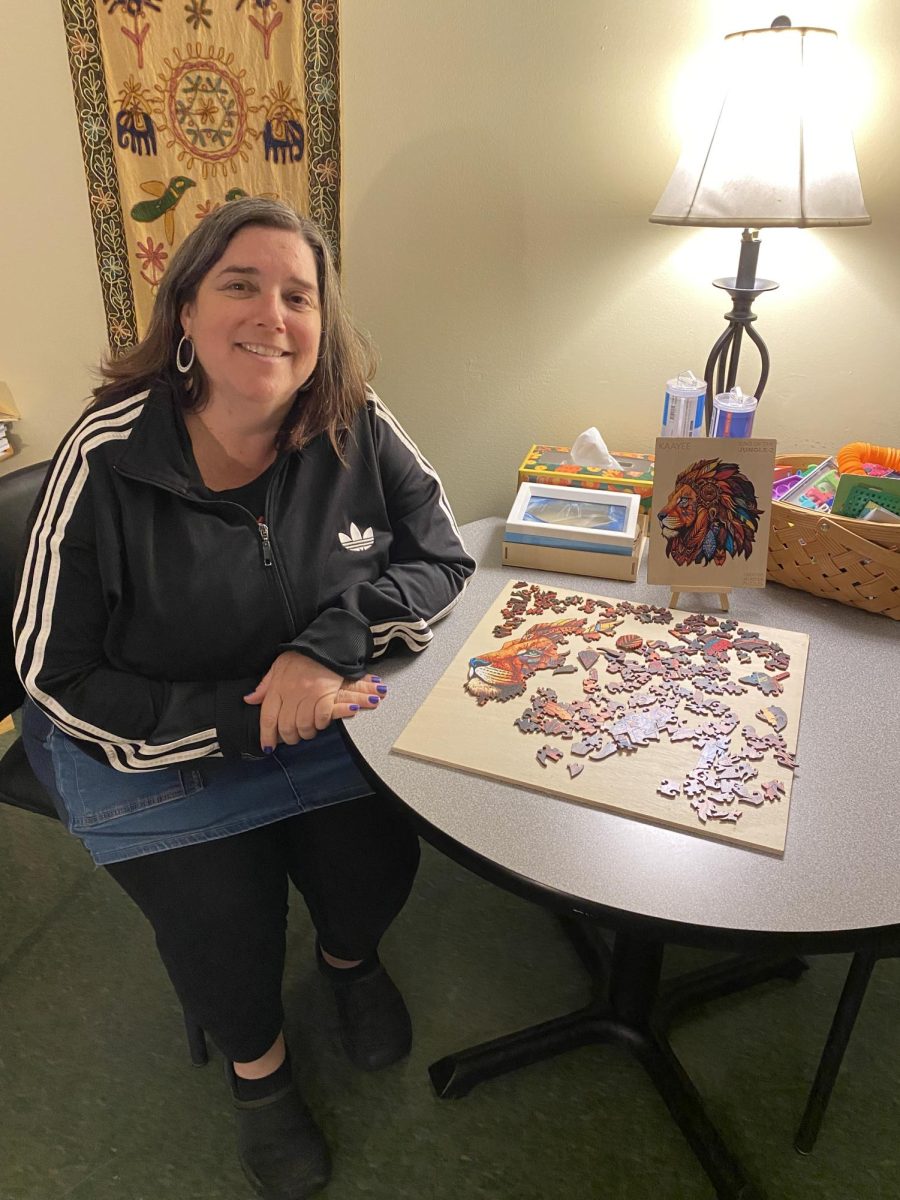
Jamie Spector, U-32’s school social worker, has had a long, eventful journey to her job at U-32. She has been across the world and country volunteering, doing work in activism, and making positive change in the communities she enters, including U-32.
Though Jamie always knew that she wanted to work with people and help others, she did not immediately know that social work was the right job for her. When she was in graduate school, a recession hit and she decided to go to school part time and work part time to pay her way through school. However, it was much harder than she expected to find a job.
“I was feeling like I knew a lot about the world, I spoke many languages, [in my studies] there was a lot of history and critical thinking and economics, but when I was looking for work, I was like, what were my skills? My hard skills?” reflected Jamie.
While searching for the answer to this question, Jamie held informal interviews for advice on how to get a job that fits with her goals. This is the first time she had ever thought about social work. “People were like, you need a kind of hard skill, and I knew I wanted to work with people. Some of them were suggesting to me, well, have you thought about becoming an accountant? I was like, I don’t want to be an accountant. Or, have you thought about nursing? Well, I didn’t want to go into medicine. And then I was talking to someone, and they said, have you thought about social work? And I was like, oh, I hadn’t thought about social work,” said Jamie. After she had this realization, she dropped out of her current graduate program and switched to one for social work.
When she graduated, she did not immediately go into the social work field directly. Instead, she decided she wanted to go abroad and help struggling communities. Specifically, she was interested in working with communities recovering from the war in Bosnia-Herzegovina. Though she could not find a paying job there, she committed to 5 months of volunteer work and bought a plane ticket.
“[NATO] basically created this huge demilitarized zone, and the Dayton Peace Accords basically divided Bosnia into these different regions, and then said, ‘Okay, now the war is over, now you’re going to make a multi-ethnic democratic country together.’ And it stopped the fighting, but I didn’t really understand the complexities of it. It felt to me, how is this peace agreement going to actually lead to peace on a social level. So I was just super fascinated,” said Jamie.
Though this was a particularly influential trip, it was not the only time she has gone abroad. In college, she did her whole third year abroad, with one semester in Brussels, Belgium and one in Buenos Aires, Argentina. She also did solidarity work with families in Palestine in 2002, and attempted to again in 2004, but was detained upon entering the country.
When she came back to the states, she tried multiple types of social work jobs but ultimately decided that she liked working in a school best. “I feel like schools are my favorite setting because there’s no stigma for walking in a public school. Everyone is here, and I feel like it normalizes support. It normalizes that everyone can be in a situation where they need support. Everyone can offer support, and I can just be another person in the building to help facilitate that,” said Jamie.
On top of this, she believes that you can have a very real impact by being a social worker and offering support. However, she does not think she could ever point to one thing that she thinks has been her most impactful. “We never really know the impact of our work. I could be walking down the hall and find someone standing in a corner crying, and I offer support. Who knows, maybe that changed someone’s life. I don’t know,” she said.
Though the work she is doing has reached a lot of kids, she believes that the best way to support kids is to teach the teachers. She thinks that because teachers are actually with students for more hours per week, it is more beneficial for them to know how to help. “Oftentimes having a social worker in a school, people are like, oh, I want to send you kids, I want to send you kids. But I mean, is it more impactful for me to sit with someone for half an hour a week, or is it more impactful for me to actually do some of that emotional translating for a teacher who’s going to be with a student five hours a week?” questioned Jamie.
Finally, Jamie reflected on the history of social workers and the long line of people who came before her. “I feel proud of my social work ancestors, and I always encourage people to think about going into social work. There’s clearly a lot of work to do, and I always say, our goal is to work ourselves out of a job. Unfortunately, we live in a society where our system is so broken that there’s a lot of work to do,” said Jamie.
Nevertheless, social work is a very rewarding field, even if there is a lot of work to do. Social work builds a community, and helps people find their place in the world. Jamie said, “As soon as I made the decision to become a social worker, I feel like in many ways I had found my people.”