This article was written by Margo Cannella, a freshman in the journalism class here at U-32.
This year, U-32 has 7 student-teacher interns in many different departments. Ray Wells and Megan Petrine are working with Bradly Parker and Christine Fitch in the science department. Max Greenwood, John Palos, and Lucy Walker are working with Nick Holquist, Alden Bird, and Erin Mooney in the English department. Maeve McCurdy is working with Christiana Martin, as well as Spencer Stilwell, who is working with Steve Sheeler in middle school for social studies. Maeve is coming from Saint Michael’s college, while the other interns are coming from UVM.
Interns participate in a one year program, the first half of the year is more casual, with a lot of observing. The UVM students come to U-32 on Mondays, Wednesdays, and Fridays for the first semester of the year. Maeve, coming from Saint Michael’s, is at U-32 only once a week. “The second half of the year is when it gets intense…my responsibilities start to get more and more serious,” intern Max Greenwood said, referring to his solo unit, which is a period during the second semester where the interns teach their own topic by themselves for a month.

The interns at U-32 are learning a lot. Max said, “Already in my first month here, I feel like I’ve learned a lot more than [in my past jobs].” Right now, the interns work with their teacher doing things like co-writing lesson plans and leading select lessons. Megan Petrine said, “I love school so I’m happy to be doing it again, and I’m feeling affirmed with this as a career path for me.” The interns are happy to be at U32, and feel like it’s preparing them very well for the future.
Megan said she was taking multiple classes currently, as well as student teaching. “I’m learning a lot about how to teach classes, how to design lessons, and then I also have classes [at UVM] that go along with my student teaching this fall.” Megan said. Class topics she mentioned being helpful to her were adolescent development; the foundations of special education; curriculum, instruction, and assessment; as well as disciplinary literacy.
The interns all have different backgrounds and experiences in and outside of school, but they all share an appreciation for learning. “I really enjoy taking a wealth of classes…after I graduated I didn’t know what to do…I went through some time thinking and I like having the real world experience,” Megan said. “It [the program] is honestly the most fun I’ve ever had in school, because all the other interns want to be there,” Max said.
There are different interests within the group for future plans. Max thinks that staying in Vermont to teach would be great, but he also expressed interest in schools with immersion programs. Max said, “I think U-32 is a great school, and I would love to teach here…I’m also curious about international schools, I think that would be really cool.”
Megan also showed interest in staying in Vermont. The scholarship program that she’s on requires her to stay here for at least two years, but she said she could see herself staying here. She grew up in Pennsylvania, and had a “rural public education. I want to help facilitate that for other people, too.”
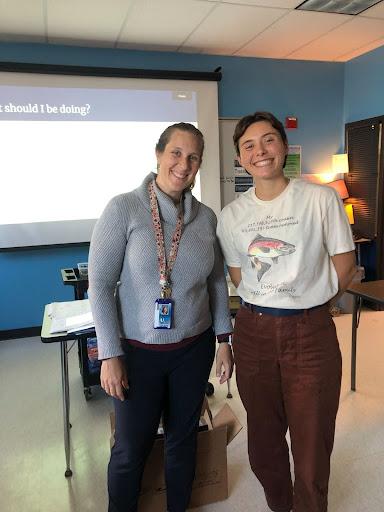
From a teacher’s perspective, Nick Holquist described why he wanted to have an intern this year, as someone who hasn’t had an intern recently. Nick said, “Ultimately I want to give back to the education community. I want to pass on some of what I’ve learned to others so that they can become strong educators and help others.”
This year Nick is working with Max in his classroom. Another reason why he wanted to have an intern this year is because it takes work. It forces him to go through plans slower, whereas normally he would be on “auto-pilot.” Nick said, “Working with an intern, I move a little more slowly, because I have to be purposeful and explain; Why do we do it this way? Why is this a good idea? Taking questions about other ways we could do it.”
Nick, like Max, thinks that internship programs are a great way to start, and a great opportunity for students looking to become teachers. Nick got an emergency certification as a teacher. He went into teaching with very little experience, and, as he puts it, “learned the hard way, with very little guidance.”
He speaks as someone who would’ve liked to go through an internship program himself. “They can start slow, and practice, see how other people are doing it, and try it out before they try it on their own…teaching is a craft, like you have to learn how to do it…it’s a good idea to learn while doing rather than jumping into it.”
Students have different perspectives than the teachers. Kalypso Anderson-Melekos, a sophomore this year, thinks that the interns in her class this year have been helpful. “She subs for the teacher when he’s gone, and I think that’s a bit more helpful if we want to catch up in class, because you actually have someone who’s educated with that topic.”
Ruby Eaton, a senior this year, has a different perspective. She thinks that she learns less when the interns take over the class, especially during their solo units. “It’s hard to switch from teacher to teacher…especially only for a month, and they’re teaching a separate lesson. It’s just more difficult,” Ruby said. Ruby also thinks that the interns need more learning before teaching and working at a school, or need to do a separate program first, to get more experience.
That being said, you can’t argue that the interns aren’t learning anything. The interns are all very motivated to learn as much as they can about teaching, and get as much out of this experience as possible.