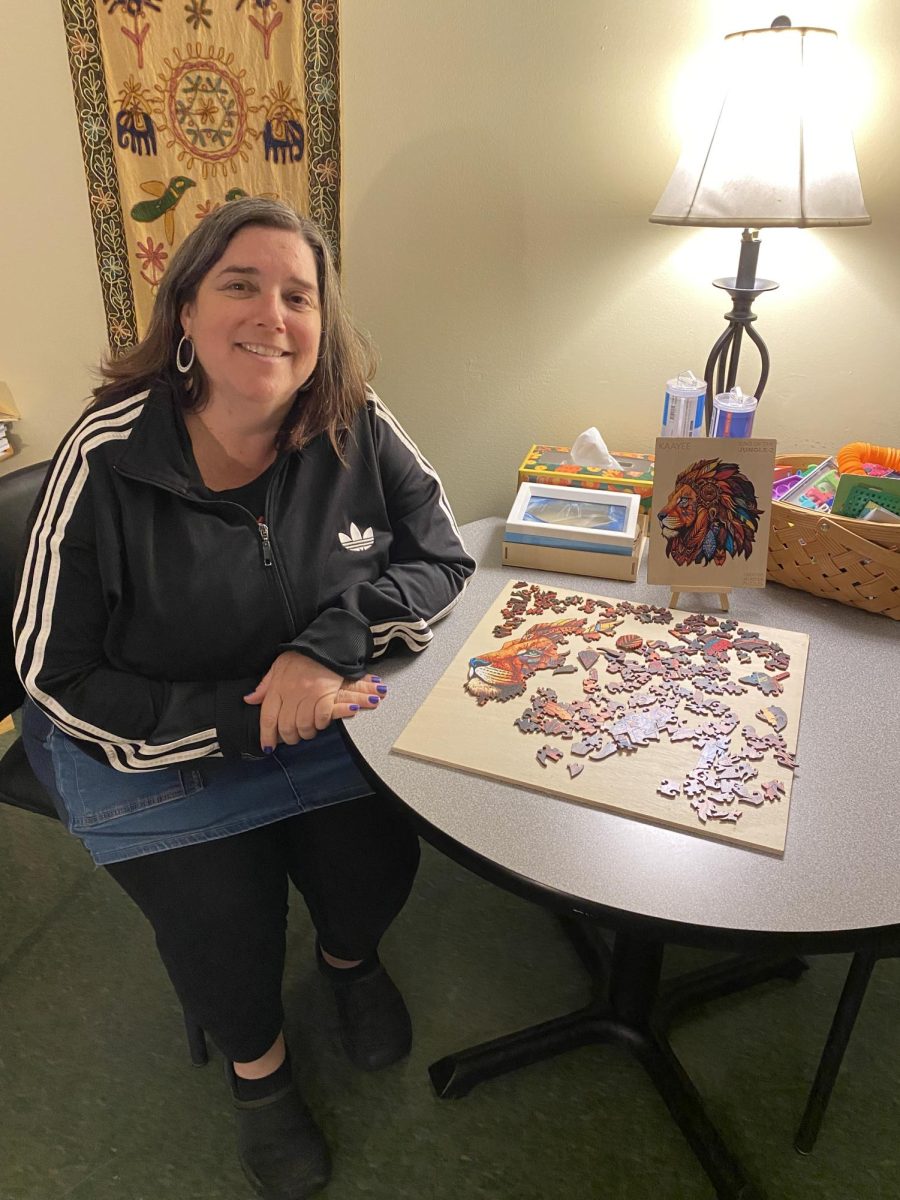
This article was written by Samara Davis, a sophomore here at U-32.
Amber McBride, African American author and poet, best known for her novels in verse such as Me (Moth), which won the John Steptoe New Talent Award, visited U-32 middle and high school Thursday, September 26th for a writing workshop and public assembly. Her day at U-32 was full of writing, exuberant questionnaires, and controversy from some students and staff.
A large factor of McBrides September visit was her latest book in verse, We are All so Good at Smiling, a young adult story that discusses topics of clinical depression, self harm, and anxiety through a whimsical forest of stories. “When you think of fairy tales, you think of ‘larger than life’ characters.” Amber said. Imagine if baba yaga had depression, snow white anxiety, or any other classic fable character plagued with mental health issues. We are All so Good at Smiling considers these themes as the protagonists Whimsy, and her friend Fairy, delve into a dark forest off cryptid fairytales, pushing them to face the complicated emotions they’ve tackled since experiencing a tragic accident in their youth. “Often we put certain people on [pedestals], but the reality is that mental illness can affect anybody,” Amber said. The book is a very personal work for McBride, having struggled with clinical depression herself. “Each circle [of the forest] is addressing a different aspect of mental illness that you might be going through, and I wanted to incorporate a lot of [what] I’d experienced so that people could relate to the characters,” Amber said. Bringing relatability to “larger than life” characters was not the only motivation for McBride. “The other aspect is, I think that fairy tales often are the first stories we have that show us morals. And having those characters guide whimsy [felt really right].” Said McBride. Amber discussed her decision of including non american fairy tales such as baby yaga, saying that she felt it added to the complexity of the story. Gwendolyn Johnson, a sophomore and avid book group attender, shared similar opinions with Amber. “It added another element, another layer,” Gwendolyn said.
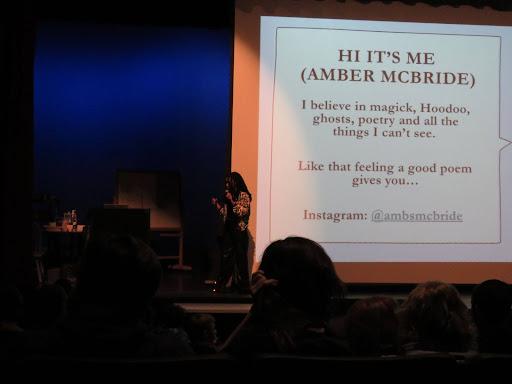
Starting with her writing workshop, McBride kicked her U-32 visit off with a bang, having two dozen students in attendance. “What I observed was students were really engaged [and] curious. There was an electricity in the room [that was] creative and generative and generous,” said Meg Allison, U-32 librarian and vital facilitator for Amber McBride’s visit. “It was really good,” said Gwendolyn. “She talked [about] how you don’t always have to follow the format, and you can write poetry about anything.” Amber herself gave insight on her writing workshop. “I always write in verse, because poetry is so much so rooted in feeling…[and] anything where I’m moving with feeling first, I tend to write in verse,” Amber said. Despite the success of the writing working, both Gwendolyn and Meg expressed that they felt the assembly was stressful and tense in comparison. “Student behavior was not at a level of what I know we’re capable of as a school,” Meg said.
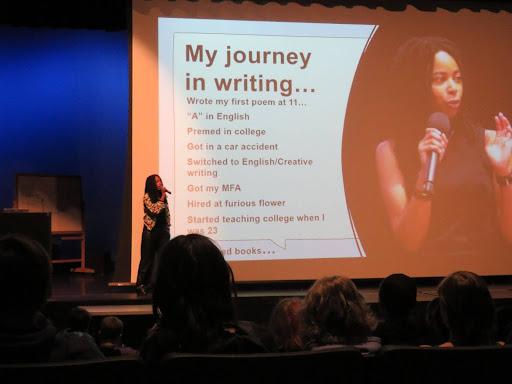
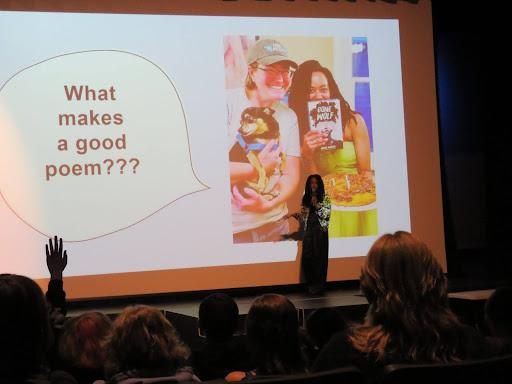
The behaviors under scrutiny were the rowdy questionnaires and audience members, who stole the show from what was intended to be Ambers twenty slide show presentation. She only got through about four. “There were a number of students who were really excited and were engaged and listening, and there were a number of students whose behavior was disruptive to the point where I felt it impacted the entire presentation for everybody,” Meg said. Questions from music to poetry to pets were thrown around the room in what Meg described as “rapid fire,” vastly distracting the assembly from its intended purpose. “When the questions all started coming rapid fire [that’s what] made me uncomfortable [because] that wasn’t what we had planned on.” Meg said that there had been an allotted time for questions at the end of the presentation that would have been more heavily facilitated by Meg herself, but that structure soon crumbled. Amber McBride has shown no disdain for the assembly or U-32, having posted positively about it on social media and offering thanks for the visit, yet the U-32 community has still held conversations with many of the middle school classes that attended the assembly. “There was a restorative prompt that Becca and the admin team created that was discussed in every eighth and ninth grade class,” Meg said. Along with this, Meg also personally apologized to Amber, as she felt she had failed in her responsibility of “ensuring that the space was to the standards that I would put for a guest of her caliber.” Meg said.
But, how can U-32 do better in the future? Meg reminisced on her own school days, saying that, “Every time we had pep rallies, assemblies, we all sat in the same seat…and it was a place of honor.” Could something like assigned seats work for U-32? The assembly started with a disruption over a student being removed from a seat, which could have been remedied by pre-ordained seating arrangements, but how might the student body respond?
Assembly attendees signed themselves up, but there were also many classes there due to their curriculum centrally focusing on McBride’s writing. Meg believes and recognizes that some of the bad behavior was due to the kids having no say in taking part in the assembly. “It’s important to hear from guests. And sometimes things aren’t optional. Sometimes it’s an extension of the learning that’s part of the curriculum,” Meg said. The question of whether students should always have a say in the curriculum they learn and the assemblies they attend is difficult, says Meg, relating it to when Holocaust survivors have visited and spoken at U-32, and the importance and non-negotiability of that attendance. Despite having higher expectations for the student body, Meg sympathized. “[I’ve been] in places where I have not been interested in the preview, [but it’s] a part of learning how to be a human and be a part of a community,” Meg said. Another possible solution posed by Meg herself was more adult supervisors. “If all the ninth and tenth graders were there, are TA’s expected to also go, and would [that] give it a different feel?” Although there seems to be more work needed to create effective and respectful presentation environments within U-32, whether that be assigned seats, more strict overviews, or more teacher presence, Meg simply implores students to attend things with open minds, as they could make unexpected connections and learnings.
Despite the fact that the assembly was raucous and rubbed some the wrong way, U-32 recognizes and upholds the importance of such congregations. “It’s really important, especially whenever we have an opportunity to engage with professionals in their field,” Meg said. She acknowledged the importance not just for students but for teachers as well. “They can give us insights that we can’t convey as teachers.” Said Meg. Gwen agreed with her, voicing her appreciation for the knowledge she gleans as a student from author visits. “It lets you see more of the world [and] learn what we could do, especially with words,” Gwen said. Not only do they believe that speaking with authors and “professionals” is vital for everyone, but also speaking with diverse voices. “She’s a black woman of such critical acclaim, she’s so respected, she’s won major awards, I think it [breaks] stereotypes of what’s possible.” Meg said. Gwen supported this idea while reminiscing about the writing workshop. “She talked about how [poetry] was something that nobody expected her to [do], and how you don’t have to do what’s expected,” Gwen said. Amber McBride herself shared similar sentiments. “My favorite part of being a writer is that I get to connect with people,” Amber said. Having been to over five hundred schools across the country as well as having been a college professor in years past, Amber is not new to rowdy kids. And, in fact, she appreciated the tenacity and energy of youths, noting that it was something she often saw lost in adulthood. “Everyone’s very rambunctious, and it’s nice sometimes to have that feeling.” Amber said. McBride shared that this high energy was one of the reasons she worked as a college professor and why she did school meet and greets in the first place. “I really feel very lucky,” Said Amber.