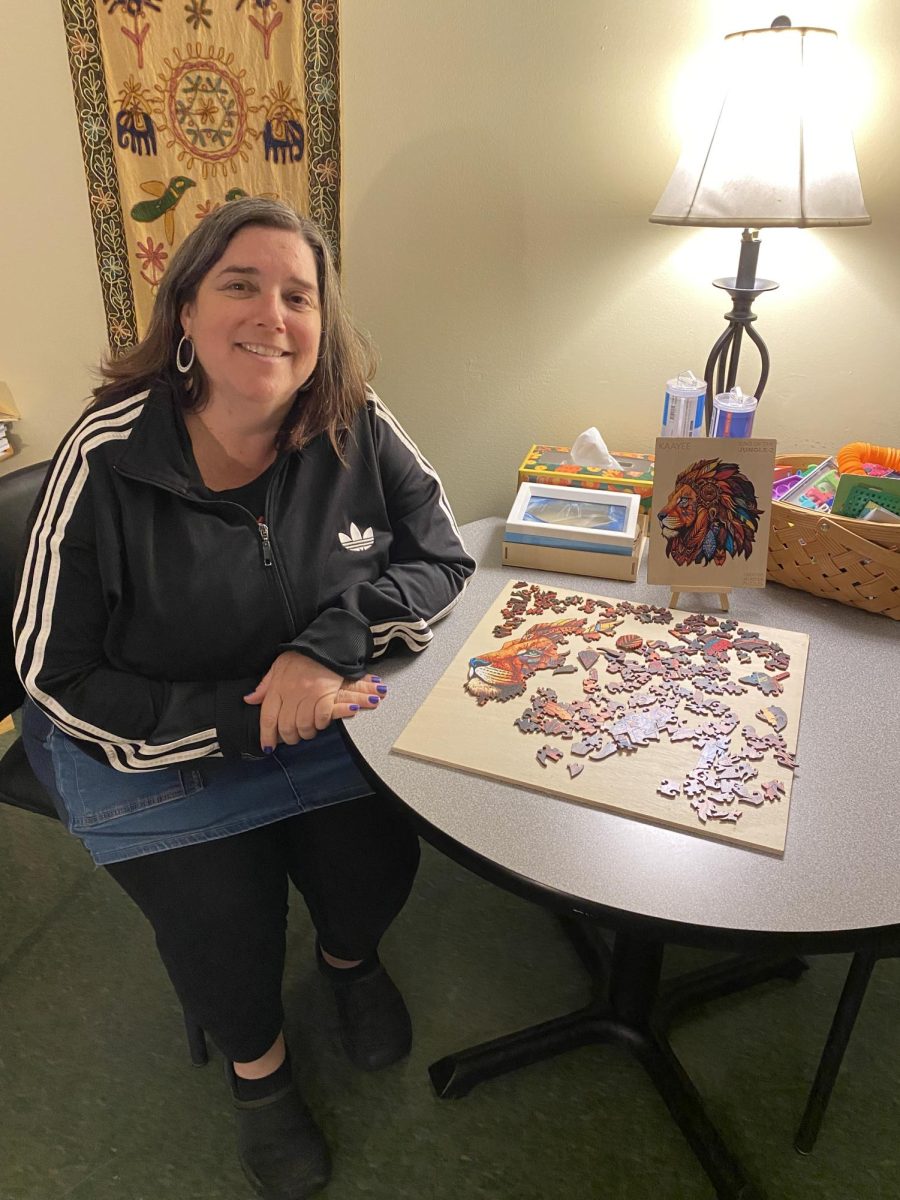
This article was written by Molly Pepin, a student in Journalism class.
Branching Out is a program offered at U-32 where students can study a topic of their choice. Many students love this course because of the opportunities the course offers them. Branching Out gives students a chance to get involved with mentors beyond the school community, which allows them to work alongside professionals. Many students have enjoyed learning new information that they don’t have access to in classes traditionally offered at U-32.
It is exciting for students to learn about topics that are not taught in school. “For me, it’s important because I get to study something that I wouldn’t otherwise have studied,” said Jonah Edson, a senior at U-32, who is studying playwriting. Students love Branching Out because they are able to develop new passions and grow their current interests.
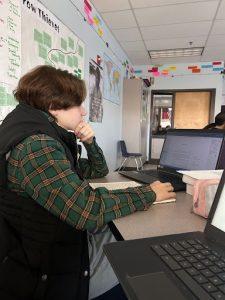
Jonah Edson doing Branching Out work. (Molly Pepin, U-32 Chronicle)
“I can really dig deep into what I’m really interested in,” said Ari Chapin, a senior at U-32. Ari has studied advanced science and math in school, he is using Branching Out as a way to expand his knowledge. Many students within the school have used the program as a way to explore a subject that they want to continue learning about.
Jonah Edson is using this opportunity to learn more about theater productions. “I’ve been a part of the theater productions for awhile, so I was like, it’d be kind of cool to make that happen myself,” said Jonah. Jonah hopes to get the chance to achieve his future goals during his study. “My larger goal is to write a musical,” said Jonah, “but my smaller goals are to write [a] play, [and] write the music.”
Other students have taken Branching Out as an opportunity to study a language that is not taught in school. “We have a section of Branching Out called Branching Out World Language,” said Karen Liebermann, the Branching Out supervisor. One language students have chosen as their study was American Sign Language (ASL). “It’s always been an interest of mine,” said Hazel Singer, a Sophomore at U-32 who is studying ASL.
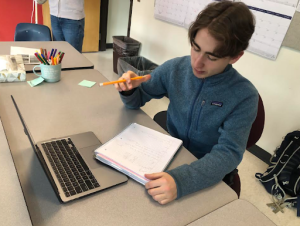 Ari Chapin deep in thought working on his Branching Out study. (Molly Pepin, U-32 Chronicle)
Branching Out is an important part of the school curriculum because it educates students on how to build an independent study for themselves. The course is mainly student-lead with support from teachers. “It provides a helpful pathway and a lot of support in making your own curriculum and stuff, and making sure you’re setting goals and trying to meet those goals,” said Jonah. Students in the program are expected to take initiative in their learning by creating their own individual study. “I like how personalized it is,” said Amelia Dubois, a senior at U-32, who is studying forest ecology.
Students in Branching Out are expected to manage their time effectively. This requires students to build a schedule when they can spend time with a mentor, and working independently. “I try as best as I can [with] blocking out time in advance,” said Ari. It feels reassuring to students when their weekly to-do list is completed. During Branching Out, students construct a weekly to-do list, reach out to mentors, and create a personalized website. Each step of the process is created by the student. “I make a list of all the things I do for Branching Out, and then I email the people I need to email, like update the website and all the other stuff I have to do,” said Amelia.
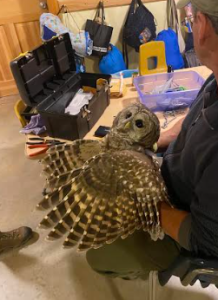
An Owl that Amelia Dubois helped band at North Branch Nature center. (Molly Pepin, U-32 Chronicle)
Branching Out is a time commitment and students are expected to set time aside for their study. It can be difficult for students to find motivation to complete tasks. “It takes a lot of putting aside time specifically, rather than just saying I want to get it done eventually,” said Jonah.
To participate in Branching Out, students are required to collaborate with a mentor. This person is an adult who is a professional in their interest of study. Students say that being with a mentor benefits their learning. “I get to talk with someone who is also really interested in the topic I’m studying, [who is] an adult, and someone who can answer my questions rather than searching them up on the internet,” said Ari.
Hazel Singer enjoys studying ASL alongside other people. Last year, she worked with a student from a different school.“That was just a cool experience to have somebody who was kind of on my level, but a little more advanced,” said Hazel.
Branching Out students have had many enjoyable experiences. Amelia Dubois, got the opportunity to attend an owl banding event at North Branch Nature Center. She enjoyed having this hands-on experience which benefited her Branching Out study: environmental science. Hazel Singer went to Williamstown to see their ASL classroom, which was a good experience for her study.
Many students in Branching Out are feeling confident with their academic progress. Students have enjoyed working alongside a mentor while also collaborating with other students. “It’s fun to see other people’s work,” said Jonah, who is working with two other students for playwriting.
Working with other people has helped Hazel Singer improve her sign language skills. “I feel confident in what I’m signing and how I’m signing it…I can do it with other people in an unrehearsed kind of way,” said Hazel.
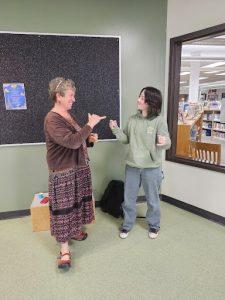 Hazel Singer practicing sign language with Karen Liebermann. (Molly Pepin, U-32 Chronicle)
Ari Chapin feels confident with being productive because he is very interested in his study. “I feel confident that I can get the stuff done that I need to do and also have leftover energy for being interested in things that I want to be interested in and really want to study,” said Ari.
Although the program is mainly student-led, it is also supervised by a teacher, Karen Liebermann. Karen meets with students one on one during their free bands. During those times she reviews a student’s study and she assists them with their progress. Karen’s main job as the Branching Out supervisor is to support students and help them get in touch with mentors.
Branching Out does not have a structured class time so Karen meets with students based on their availability. In the beginning steps, Karen helps students initiate their study. “It might be reaching out to potential mentors in the community, talking to potential mentors about what they might be interested in,” said Karen.
At the end of the year, Branching Out students must showcase what they’ve learned. “By the end of the year, they’ve got an online portfolio website that shows what they’ve learned,” said Karen.
It has been exciting for Karen to watch student’s presentations. She loves watching how students show their creativity in a presentation. One previous student constructed a kayak for his presentation. “It was so exciting on the day of his final presentation because we were at Curtis pond, and he was launching his kayak and paddling it,” said Karen.
Karen says that Branching Out and Community Based Learning have similarities and differences. In Branching Out, Karen works with 9th through 12th graders, and CBL is only for 11th and 12th graders. CBL is one semester long, but some students take it for a year. The learning process in CBL is at a faster pace. “You have to take this whole process that’s kind of hard to do, like crafting goals and figuring things out,” said Karen. Students have to begin their studies faster because of the limited amount of time they have.
Karen loves to watch how students take action in their studies. “The other fun piece is seeing where people go with these adventures,” said Karen. In past years, Karen says that some studies have been “obscure.” Years ago, one student became interested in learning to play the sitar, an Indian string instrument. Karen said, “She became a professional sitar player.”