


Editor’s Note: This article includes reporting from the entire chronicle team.
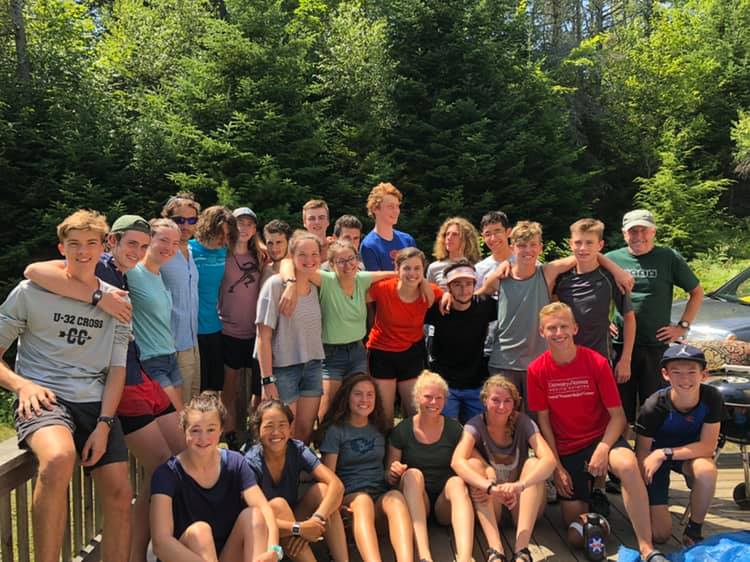
This week members of the U-32 Cross Country team challenged a policy that would force them to choose what mattered more to them: climate change activism or competing in cross country.
Though they hoped to attend both tomorrow’s Youth Climate Strike and participate in a meet on Saturday in Manchester, New Hampshire, school policies mandate that students who miss school on Fridays may not attend co-curricular functions on Saturdays.
Friday’s Youth Climate Strike is one of thousands across the globe. Similarly to the School Strike for Climate in March of this year, this strike intends to call governments across the world to action in response to the effects of climate change that have already begun.

Ginger Knight and Jed Kurts, members of the cross country team, led an effort to get an exception. The team met with principal Steven Dellinger Pate on Wednesday. The students came with a petition and a letter from Bill McKibbon, the writer and climate activist.
[showhide type=”1″ more_text=”Show Letter” less_text=”Hide Letter”]
Dear Principal Dellinger-Pate
I’m a resident of Ripton in the Addison County Supervisory District, and I spend mych [sic] of my
time working on climate issues around the world. I was writing because I had heard from
members of the U-32 cross-country team who had wanted to take part in the global climate
strike on Friday that they would be denied permission to compete in their meet the next day if
they did so. That seemed perhaps a hasty decision to me, and I hoped to provide a few reasons
that your administrative team might consider in reviewing the case.
First, the climate strikes truly are global in scale. This is a youth-led movement now
encompassing the globe. I’ve just come this evening from a program with Greta Thunberg in
Washington DC—the Swedish high-schooler, who was awarded Amnesty International’s highest
honor tonight—and it was clear she has galvanized enormous numbers of people around the
planet. Friday’s climate strike will almost certainly be the biggest global day of climate action
yet. Since the global climate movement really began with Vermont young people at Middlebury
College a decade ago, this new development has been highly gratifying to watch.
Second, administrators around the country and around the world are encouraging students to
take part, understanding that it is a profoundly educational moment. As a teacher myself (in the
environmental studies department at Middlebury) it seems to me the pinnacle of our
profession when we see young people taking the messages of the classroom and applying them
to the world. You should be very proud of the work you and your colleagues have done to instill
in these students a knowledge of earth science and of political science as well. That’s why, I
think, the mayor of New York last week announced students in that city could be absent from
their classrooms on Friday without punishment. I was on a stage in Houston last night with
that city’s mayor, and he made a similar gesture; indeed we’re seeing the same thing happen
around the world.
Third, let me say something in particular on behalf of endurance athletes in particular. I’m not
a good runner, but I am a dedicated Nordic skier (indeed I wrote one of the very few books on
the subject in English), and served for many years as the faculty adviser to the cross country ski
team at Middlebury. I’ve come, therefore, to appreciate the distinctive character of endurance
athletes. I would be surprised if these students were not among the more disciplined of your
charges; I imagine they would be able to keep up with their work even if they missed a day. And
in any event, it seems like they’d probably learn some things in the process of joining Friday’s
rally. It seems to me like a “teachable moment.”
Fourth, let me just add that perhaps some of you and your staff might consider joining in.
Though there have been a year of school strikes, this time young people have explicitly asked
their elders to take part too. It does, after all, not seem fair to put the burden for solving the
planet’s biggest problem solely on the shoulders of 17-year-olds. I note that Vermont educator
Jon Isham, a Middlebury economist, has coordinated a worldwide drive to get college and
secondary school teachers to join in this strike, an initiative that’s been joined by thousands of
like-minded colleagues.
I am in transit much of this week, organizing along the East Coast, and will sadly be in New York
on Friday, missing the events in Vermont. But if I could answer any questions you might have
about the meaning and significance of the day, I’d be happy to give it a try. I’m at
With best wishes for a fruitful academic year, and with thanks for your good work,
Bill McKibben
Schumann Distinguished Scholar in Enviromental [sic] Studies
Middlebury College
Jed Kurts and Ginger Knight spoke with the Chronicle after practice on Thursday afternoon. “This policy does not allow for any exceptions,” Knight said, “and we felt that it was unfair for there to be consequences for people who do athletics and who happen to have a meet on that Friday, or Saturday, that would prevent them from going.”.
“I think the most educational thing you can do is to show up to a global event,” Kurts said, “especially an event that aligns with our mission and transferable skills, like engaged citizenship, expressive and effective communication.”
“I think this strike overwhelmingly is way more educational than even a day at school,” Kurts said “And if you could get teacher permission to go attend that, I think we definitely should be able to attend.”

Climate Strike in March, 2019
Some feel as though the school allowing those with permission slips to attend the rally without penalty, took the power away from the protesters. Writing in response to the climate rally in March of this year, Bruce Pandya argued that, “If an officially approved demonstration or protest was truly dangerous to the status quo, it would not be allowed to operate.”
For further thoughts on this, read: Opinion: Burn Your Permission Slips. Not Really, But Maybe
The morning after the cross country team met with Steven, he sent an email to the student body that clarified that he would adhere to the handbook policy:
“We will reach out to notify families of any student who leaves without permission. Students who leave school with parental permission to attend the climate strike will be responsible for any and all missed school work and those who participate in co-curricular activities will not be able to participate in after school or Saturday events, per the Student Handbook.”
He referenced a memo from the Vermont Agency of Education stating that “at a time like this, we need to hear our students’ voices more than ever. That said, the right to free speech does not extend to disrupting classes (which prevents others from learning), nor to leaving school without permission (which potentially causes a safety threat).”
In the email, Steven does not discourage students from attending Friday’s rally. He ends the email by acknowledging the political importance of civil disobedience and says, “I encourage our families to have discussions about the pros and cons of participation and to make decisions that match their convictions.”
[showhide type=”2″ more_text=”Show Email” less_text=”Hide Email”]
Dear U-32 Community,
On Friday, September 20th, students around the world are planning actions to raise awareness of the climate crisis. At U-32 this action is being called a Climate Strike. This is not a school sponsored event, and like the climate walkout last year, the school will not be excusing the absences. While we support our students to be engaged citizens and to contribute to their local and global communities, we must also adhere to our own policies and procedures. We strive to support our students and maintain consistency in our adherence to policy.
The Agency of Education gave some guidance in the field memo of 2/23/18: “Vermont has a strong tradition of student voice, and we celebrate our students for their efforts to engage in and positively shape the future of our state. And at a time like this, we need to hear our students’ voices more than ever. That said, the right to free speech does not extend to disrupting classes (which prevents others from learning), nor to leaving school without permission (which potentially causes a safety threat).”
We cannot allow students to leave school without permission and those that do will face disciplinary actions. We will reach out to notify families of any student who leaves without permission. Students who leave school with parental permission to attend the climate strike will be responsible for any and all missed school work and those who participate in co-curricular activities will not be able to participate in after school or Saturday events, per the Student Handbook.
I am proud of our students who choose to engage in safe public demonstrations and exercise their constitutional rights to do so. Civil disobedience has been used to create great social and political change throughout our history. I encourage our families to have discussions about the pros and cons of participation and to make decisions that match their convictions.
Sincerely,
Steven Dellinger-Pate
The Student – Parent handbook is clear about the policy.
“Students who participate in co-curriculars at U-32 and are absent on a Friday must have permission from the athletic director to play, perform, or practice on Saturday,” the policy reads. “This permission is generally only granted for extreme reasons- being sick on Friday is not one of them.”
It doesn’t matter whether the student has permission from home: “a note excusing the student from a parent or guardian may not be accepted.”
The cross country team is not the only sports team or extracurricular that would be forced to make a decision. This weekend was initially scheduled as homecoming weekend. This means that nearly every varsity team has a game or event on Friday or Saturday of this week.
Some members of the cross country team, including Sam Clark, Ayla Bodach-Turner, and Tzevi Schwartz decided to go to the rally, accepting their ineligibility for the meet tomorrow. Many others decided to stay at school and will race in the meet.
Waylon Kurts and some of the other runners on the cross country plan to walk out during the school day, remaining on U-32 school grounds. “Instead of having to abandon our idea and concede,” he said. “We can walk out at callback.”
The policy is clear :“To participate in co-curricular functions students must attend a full day of school or school-related activities, including callback.” However, as the team does not plan to leave campus, this potential walkout will not prevent them from being able to attend their sporting events.
Alex Saunders, a junior on the cross country team, said that he stands with the cross country team but does not believe that the school should take a stand on the issue. “I don’t like that it has come to this, but the fact that climate change in this current state is a political issue, and being a public school unless there is something by the state that says this is what we entirely stand for, which even Vermont being progressive, it hasn’t really done, it can’t really take a stand in saying that we can support this action.”
Jed Kurts still feels the school should have made an exception to the policy.
“I respect his decision because he’s the principal. I respect the precedent,” Kurts said.
“I feel like it didn’t get nearly enough thought, and I know everyone on these teams got behind our beliefs really fast, got through all the right hoops. I think it’s ridiculous that we’re not going.”
This debate between the administration and cross country team raises a few questions.
Although climate change is now an integral part of our curriculum at U-32, does a public school have the right to endorse and excuse absences for a political rally?
What should U-32’s role be in pushing students toward political and social activism?
And does civil disobedience lose its merit if it is permitted by a tax funded institution?
U-32 is responding to this debate the same way it responds to many political events: via email. On Wednesday evening, U-32’s student body received an email from the Youth Action Alliance. With the subject line “We’re f*cked”, this email intended to call attention to an event already buzzing among the student body.

Some students have shown no interest in Friday’s climate strike. One sophomore “replied all” to the Youth Action Alliance email stating, “Don’t send this to me please. Go drive a Diesel”.


