


This article was written by Grace Cannella, a student in the Journalism class.
U-32 librarians, Shezamm and MOST club members are striving to make the school a better place by addressing misogyny, feminism, and banned books. These topics within the school and the world are important to talk about, because talking leads to action.
Library
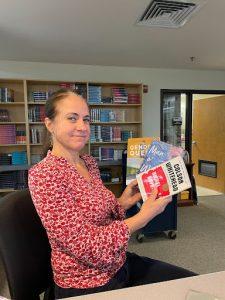
Meg Allison holds 3 books banned in other states. The U-32 library specifically buys banned books. (Grace Canella, U-32 Chronicle)
The U-32 library “protects a young person’s freedom to read books that they want to read,” said Meg Allison, a librarian at U32.
All over the United States, books have been banned in public schools. These books are brought to the attention of parents and staff on the basis that they are not appropriate for kids to be able to read. The book banning process is different depending on state, as well as school/library. Meg says most of the challenged books contain topics like race and class. Meg said there is also, “a targeted campaign against books written from people from historically marginalized identities.”
Every year, the American Library Association (ALA) makes a list of the most challenged books in the US. A challenged book means there is a possibility the book will get banned In the U-32 library, “I make sure we have at least one copy of all those books,” Meg said.
New policy has been passed by the WCCUSD school board. It endorses the Library Bill of Rights instituted by the ALA. The new policy also states information on how new books are brought into the library. It also dives into how a complaint about a book should be handled. This policy was introduced on 12/20/2023, and was effective starting 1/3/24. The Vermont State Legislature also passed act S220. This act relates to Vermont public libraries selecting new library materials.
Meg believes that this new WCCUSD policy supports what the U-32 library stands for. “Our task in our library is to develop a collection that is inclusive and diverse and celebrates the full humanity of all our community members, of all our students, and really challenges students to grapple with complex topics and issues.”
Clubs:
Shezamm
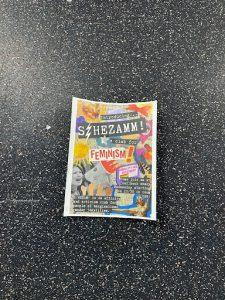
A poster advertising Shezamm, on a bulletin board in U-32. (Grace Cannella, U-32 Chronicle)
Shezamm is a new club at U-32 that revolves around feminism. It was founded by student Evelyn Rocha. Evelyn had the idea for this club since seventh grade. “I wanted a place to be as a woman, where I could feel safe and I could talk about things that bothered me, or take action or educate people,” she said. Now as a senior who is in Pilot, Evelyn has time to put her dreams into action.
Shezamm is a new club, and Evelyn has many goals for the club’s future. A big goal of Shezamm is to “get rid of the stigma of feminism that it has nowadays, and help people understand and learn what it means to them,” she said.
Shezamm members talk about struggles with misogyny and what being a feminist means. Evelyn also hopes to discuss reproductive justice history, sexual assault, and sex education. She hopes to empower people of all genders to fight for “the belief that gender should be equal and everyone should be respected,” Evelyn said.
Shezamm wants to collaborate with other clubs on campus such as BLAAM, GLAAM, Seeking Social Justice and The Conversation. Evelyn hopes to continue these conversations and action around feminism at U-32, even after graduating. “I want people to be able to see those things for what they are, so that we can fight against them more fully,” she said.
MOST
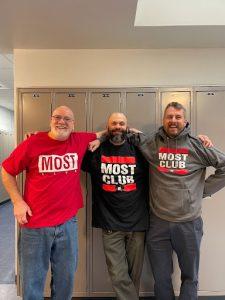
The leaders of MOST (left to right), Brian Albee, Mark Brown, and Nick Holquist. (Grace Cannella, U-32 Chronicle)
MOST stands for Men Of Strength, a club at U-32 that promotes healthy masculinity. The club is part of the nationwide organization. The leaders are Brian Albee, Mark Brown, and Nick Holquist. There are more than 25 members.
Brian Albee is a leader of the club because, “Number one, I thought it was a really important issue. Number two, I can have a positive influence on members of the club,” he said. Brian, Nick, and Mark are role models for the members of the club.
MOST members have many conversations in their meetings around dating violence and sexual assault. Phin Hilferty, a member of the club, believes that MOST can change the norms of U-32.
Phin said, “There’s a lot that needs to be changed. If I can be part of a group that stands up for how men should treat women, and how a good gentleman should be, if that’s a club I can be in, I would like to be in.”
Much of the club’s conversations are centered around rape, dating violence, and the patriarchy,making those conversations difficult, but necessary for change.
“They want to avoid it because they’re too uncomfortable about it. So we want to bring it to the forefront. We want to make it so that it’s okay for people to be aware that it happens, and we need to talk about it,” said U-32 MOST club leader Brian Albee.
MOST strives to reconstruct the negative social norms in situations of sexual assault. During April 2024, MOST and The Conversation collaborated on a presentation about this. About 60 people attended this presentation. Brian said,“I believe that every male needs to know the importance of healthy masculinity, to treat women well and with respect.”
A typical club meeting consists of looking at videos, statistics, or news, and then having conversations about what that means. Members then break up into smaller groups, so the discussion can be “more personalized,” Brian said. Members can take breaks during conversation, “This stuff might be sensitive to some people, and we give them an out if they need to step away for a little bit,” Brian said.
Phin said, “A big problem with this stuff is that it’s not spoken about…So our hope is to get that voice out there.”


