


This article was written by Inkwel Young, a student in the journalism class.
The changing of fall foliage is important to the people of Vermont. As the leaves begin to change there is an influx of tourists known as “leaf peepers” coming to see the foliage. This is a consistent moneymaker for Vermont businesses.
Leaf peepers travel to Vermont to see the colorful leaves. Vermont has much more vibrant autumn foliage than most places in the U.S. Amy Urling, a high school science teacher at U-32 grew up in California.
“We didn’t have four seasons, and I just love how every season is so different here,” said Amy. Her mother, who’s favorite season is fall, comes to Vermont every year. She lives in Las Vegas and likes to visit when the colors are at their brightest.
These tourists have a large impact on local traffic. Jill Abair, one of the librarians in the U-32 library said “My typical drive home is about half an hour, and during foliage season, it’s about an hour.”
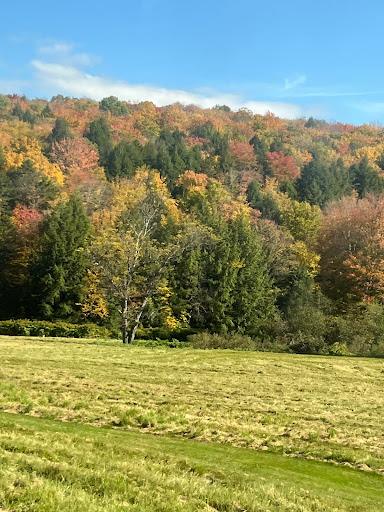
Autumn leaves in Worcester VT. (Inkwel Young/Chronicle)
Karissa Reid is a sophomore at U-32. She noticed a difference between the fall season in Florida and Vermont. “I’m from Florida, and it’s not very nice looking. You can barely tell when it’s fall,” she said.
Vermonters are also fond of the colorful autumn leaves. “It’s just something really interesting about the colors, the vibrancy, the beauty of it all,” said Jill Abair, “it’s just something really pretty, the contrasts of the reds and the greens.”
The reason Vermont has such eye-catching colors is because of a scientific process called photosynthesis. The reason that leaves are normally green is because of a pigment called chlorophyll. It is responsible for converting sunlight into sugars during photosynthesis. Chlorophyll is normally the dominant pigment in the leaves, making them appear green.
Brian Albee, who teaches forest ecology at U-32, said “During the fall, two things happen. Number one, the days are getting shorter, so there’s less hours of sunlight. Number two, the temperatures are decreasing, and so between the shorter hours of sunlight and the cooler temperatures, it starts breaking that chlorophyll down.”
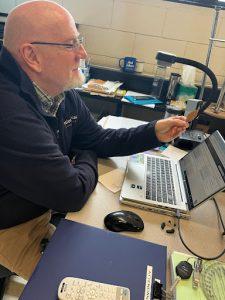
Brian Albee, high school science teacher at U-32 “Looking quizzically” at a leaf. (Inkwel Young/Chronicle)
“Leaves have many different colored pigments in them all the time, reds and oranges and yellows. It’s just during the summer, the chlorophyll, which is the green, is so dominant that that’s what we see.” said Amy.
The other pigments that are responsible for autumn colors are called carotenoids and anthocyanins. “So, those pigments are always in the leaves. It’s just that during the fall, the green chlorophyll starts to break down,” Amy said.
With the chlorophyll in the leaves no longer present, the other pigments become visible, causing the vibrant fall colors. “Not only is it changing colors, but it loses the flow of liquid like water and sap up to the leaf, and that allows the leaf to dry out. Eventually that allows the leaf to break off,” said Brian.
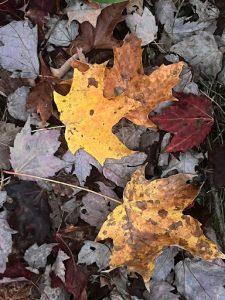
Fallen leaves in Worcester VT. (Inkwel Young/ Chronicle)
During the recent years, Vermonters have been noticing differences in the color of the foliage in fall. “I think that we have had more years of poor color of late, than we have in the past. If I look back over the past 20 years, I think in the past four or five years, there haven’t been consistently super, great colors,” said Brian.
Brian is not the only person who feels this way. “I feel like the leaves lately haven’t been as bright. I feel like within the last couple of years, they went from more of an orange to a darker brown,” said Karissa.
Jill Abair also noticed the differences.“I feel like they haven’t been as vibrant in the past few years as they may have been in the past,” she said.
The reason that color varies year to year has to do with the tree’s environment. While the amount of daylight does not change from year to year, the temperatures do. Brian Albee said, “If the temperatures are cooler or not as cool, it’s gonna have an effect on how vivid those colors are.”
It is a concern that climate change could disrupt the beautiful colors that Vermont is known for. Colder temperatures create the most vibrant colors. “Tomorrow’s the first day of October, I kind of expected us to be further along with the colors this year, and I suspect the warmer weather has kept it from getting there yet,” said Brian.
Jill said, “I’m a little worried now, with the rain that’s come through in the storms. Worried about the leaves having fallen off the trees. Whether that’s impacting the color, I would say so.”
(More information on climate change and fall foliage in Vermont can be found here).


