


This article was written by Margo Cannella, a student in the Journalism class.
This is U-32’s third year of J-Term. J-Term originally started as Year End Studies in 2023. The J-Term committee decided to change it from June to January, for last year and this year. J-Term is an opportunity for students to choose courses of interest that aren’t offered during the normal school year. From January 22nd to January 24th, U-32 students can be found playing winter sports, making sushi, felting, painting, and many more activities.
J-Term has been a long time coming at U-32. “There was a previous group [a J-Term committee] that brought it forward around 10 years ago,“ said Karen Liebermann, one of the teachers on the J-Term committee. She said that there was a proposal a while ago, and it started to be discussed more after COVID.
Sean McIntyre is a middle school English teacher, and he is also part of the J-Term committee. Sean was part of a program like J-Term at Hazen Union School, when he worked there in 2017. Then after COVID, having J-Term at U-32 was brought up again.
Sean said, “I heard a few rumblings of ‘Maybe we’re gonna try it here’, and I was definitely in support of it.”
Karen invited Sean to join the J-Term committee, which at first was mainly focused on how J-Term could happen at U-32. Some other teachers on the committee joined because of similar experiences to Sean’s.
The school brought J-Term to U-32 after looking at models of other schools taking a break within the school year. J-Term is a good opportunity for students to learn about things of interest to them during the school year. It also allows students to build relationships with people they wouldn’t meet otherwise, because most courses are mixed with all grades.
“All of those things then help us to learn better, and be a better community together,” Karen said.
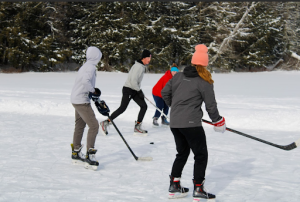
Students play pond hockey during 2024 J-Term, (Courtesy of Dillon Burns)
There are so many courses for students to choose from. Some examples of courses are painting, pickleball, skiing, cooking Italian food, and so many more. The courses are sent out in lists, and then filtered through from student input. Sean mentioned that this year there is very high interest in the cooking courses.
“We start with [coming] up with the ideas, and we’ll see if we can make it possible,” said Karen.
Part of making the courses possible is getting the resources for each course. Karen spoke about donations that U-32 has gotten, for the cooking courses especially. She said we’ve asked for specific donations, such as butter, for pastry making.
“We ask for donations from the community on a lot of levels,” said Karen.
The courses during J-Term are mainly taught by U-32 teachers, but there are a few volunteers. “Every course has at least one faculty post, so there’s a teacher that provides space…we do have some volunteers, for example we had a hunter safety course, and that was provided by VT Fish and Wildlife,” Sean said.
Alongside volunteers there are also some U-32 students teaching courses. The student teachers are mostly seniors, and they have a U-32 teacher with them. Some J-Term courses stem from already established clubs, for example certain art clubs, and the military history club. Some upperclassmen club leaders are leading courses, such as Colby Tuller, leading a course about military history.
“[U-32 clubs] can use J-Term to have more time and space, and to invite more people into them,” Karen said. She said that she likes the idea of dedicating more time to the clubs during J-Term.
Getting each student with their own schedule for J-Term is a complicated process. It’s the same process of registering for regular school courses, and it happens through Infinite Campus (IC).
“Everyone in student services has helped us a lot…with the logistics of scheduling courses,” said Georgia Cody. Georgia is on the J-Term committee, and is a middle school math teacher at U-32.
The courses are distributed so the seniors have top priority for their first pick of courses. Usually students get all the courses they sign up for, unless the timing of their chosen courses conflict. Timeliness is important regarding the requesting of courses. If the deadline is missed, students will be left with courses that they didn’t request.
With the budget under stress this year, it brings up the question of how much J-Term costs. Karen said that last year it cost roughly $11,000 total. She said it seems like a huge number, but not compared to what U-32 spends over the course of the regular school year.
Although U-32 gets some of the resources by donation, the cost for the materials that aren’t by donation come from the department budgets, and the resources purchased from the department budgets are something that U-32 would buy for a normal school course. The total cost of J-Term is pulled from many separate budgets.
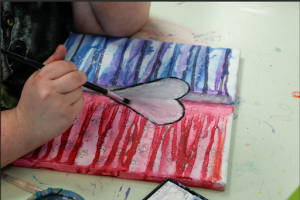
A student painting during 2024 J-Term. (Courtesy of Krista Dy)
The J-Term committee does things to keep the cost down, and the goal is to “make sure the cost of it [J-Term] doesn’t keep anyone from participating,” said Karen.
One course that costs a particularly large amount of money is skiing at Bolton Valley. “When there is a cost to the activity we tell the families ‘Hey, this is the cost of the activity. Pay what you can towards that’,” Karen said.
She said that some people pay extra for the people who can’t pay all of it, and some community members have donated, even if their child isn’t participating in that activity. It’s a combination of all of those factors that make it possible for every student.
Budget, picking courses, course registration, and many more things are what the J-Term committee focuses on during their meetings. The J-Term committee meets every Tuesday after school for an hour.
The J-Term committee consists of volunteers from U-32. Many of the people on the committee joined because of hearing about events like J-Term at other schools.
“I heard of this in other schools, and I wanted to get more involved with the school community,” said Georgia.
Because J-Term is in January this year, like it was last year, the committee meets every week consistently throughout the first semester. In the second semester they start to meet a little less.
“Right before break we had a really busy time because it was student sign ups, through IC,” said Georgia.
During committee meetings they focus on sending information to staff members, like giving instructions on what to do during TA with students. After J-Term is over the committee will spend the rest of the year gathering student feedback.
There is a lot of excitement from students about J-Term this year. Braden Abrahamson, a junior at U-32 said, “I’m excited to go skiing.”
Mya Gould, a junior at U-32 also enjoys J-Term, and the option of skiing. She’s excited for skiing, but she also said that she would like J-Term better if it was in the spring, like it originally was.
“I think J-Term is fun, but I definitely feel like it was better in the spring, because you got to go outside, and use the track, or tennis courts, or the fields,” Mya said.
Addie Gould, a freshman at U-32 said she also enjoyed J-Term better when it was in the spring. Despite her lack of enthusiasm for the winter course options, she said she signed up for candy-making, and she hopes she gets it. “I really like candy,” said Addie.
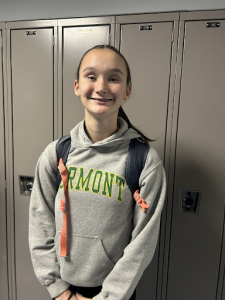
Addie Gould, a freshmen at U-32 (Margo Cannella, Chronicle)
Sean said that in the future he hopes to be able to include students in the J-Term committee. He, Karen, and Georgia all spoke highly about student input, and the need for it.


