


By Grace Canella, a student in U-32 Journalism Class
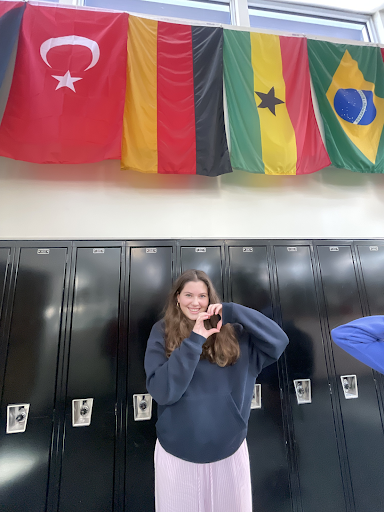
At U-32 this year, there are three exchange students, Aurelia Torres Bauer, Dilnaz Satmoldina, and Leni Loeddemann. Aurelia and Leni come from Germany, and Dilnaz comes from Kazakhstan. As school policy, U-32 is allowed to have three exchange students each year.
Exchange students impact U-32 in a big way. Sarah Volinsky teaches Spanish at U-32. She says, having new students in a classroom brings a new perspective on complicated topics. “They hear it from their teachers, but they don’t believe us, but if they hear it from someone their own age, it feels a little more realistic,” she said.
Becca Tatistcheff, school principal, thinks exchange programs help students connect with one another. She said, “It has the potential to build deep empathy.”
Becca worked with exchange students and programs in the past. Exchange students benefit the people from the host state. It benefits Vermonters by “…Build[ing] understanding of where other folks in the world come from and their experiences.”
These students have many different reasons for traveling so far from their homes. Aurelia has cousins that came to the US and wanted to try it. She said, “I kind of grew up with them being away, then I wanted to do the same.”
Her mom also did an exchange program in the US. “She had a good experience,” Aurelia wanted to follow her family’s footsteps.
There are many different programs for exchange students. Leni is here with Congress-Bundestag Youth Exchange (CBYX). It was founded by the US and Germany after WW2. This program sends American people to Germany, and vice versa.
Dilnaz is here with Future Leaders Exchange (FLEX). The FLEX program was created to help bring understanding from Eurasia to the US. Both of these programs are government funded with scholarships.
Host families often limit the possibility of having exchange students at U-32. Karen Liebermann is Leni’s host parent and also works at U-32. She thinks that students being around exchange students helps build awareness of American culture.
As a host family, Karen gets asked a lot of questions about the US. When explaining everyday things, it makes her realize a lot from what she is asked to explain. She said, “Interacting with exchange students is a step that’s really accessible to start to understand other cultures, and understand our own in different ways.”
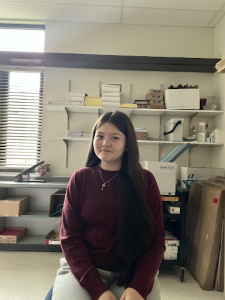
Dilnaz came from Kazakhstan with FLEX, where a student gets placed in a US state. Dilnaz has seen lots of media that portray America in certain ways.
“People are mostly free,” she said, about how people act here. “Generally, Americans also can do what they want,” she said, “People will not try to stop you from doing something, so you have many more opportunities.”
The school system is different in their home countries. In Aurelia’s school in Hamburg, Albrecht Thaer Gymnasium, the schedule is much different. The classes are 1:30 hours long, followed by a 30 minute break and that repeats. Students can only make their own schedule in 11-12 grade. There is more variety in classes here compared to her school in Germany.”
Also, Aurelia thinks teachers are a lot more strict in Germany. “There’s more of an authority between teachers and students. Here everyone is way friendlier, like they would be friends.”
In Kazakhstan, Dilnaz’s teachers care about their students’ grades and classwork. About U-32 teachers, she said, “Here teachers can notice if you are in a bad mood, and they ask you if something is wrong, to try to help.” At home, she doesn’t have the same kind of teacher support. “Teachers here are more caring for you and your personal life.”
Dilnaz’s school requires students to wear uniforms. In Kazakhstan, Dilnaz has to wear a formal white top and dark blue pants. There is no dress code enforced at U-32.
Additionally, sports are a big difference between the exchange students’ hometown schools vs U-32. Aurelia’s school does not have any sports, only a few clubs outside of school.
Here, Dilnaz plays on the MHS JV Volleyball team. She thinks the team is more close here, than at home. “I love my volleyball team…and the girls there are awesome.”
On her team at home, the way people acted towards one another was, “kind of like colleagues, more formally.” The team here does regular team bonding activities, something that doesn’t happen on her hometown team.
The art program at U-32 is different from Leni’s school. Leni comes from Kamen, Germany. At her school, they have a general arts class. There are no classes for specific types of arts, such as photography.
At U-32, Leni said the art program really sticks out to her. “I have three art classes, which is amazing.” Leni is taking pottery, jewelry, and photography. There are not many required classes for exchange students.
These students come from urban areas, so moving to rural Vermont is a big change. Dilnaz comes from Temirtau, a city in Kazakhstan. The nature here impressed her. “In Vermont, you don’t have light pollution…I just can’t turn my eyes from the sky and all the stars.”
Aurelia also lives in a big city with a lot less greenery. Aurelia thinks Hamburg is much more city-like compared to Vermont. She said about Hamburg, “When you go outside, you only see houses and shops and buses and trains.”


